
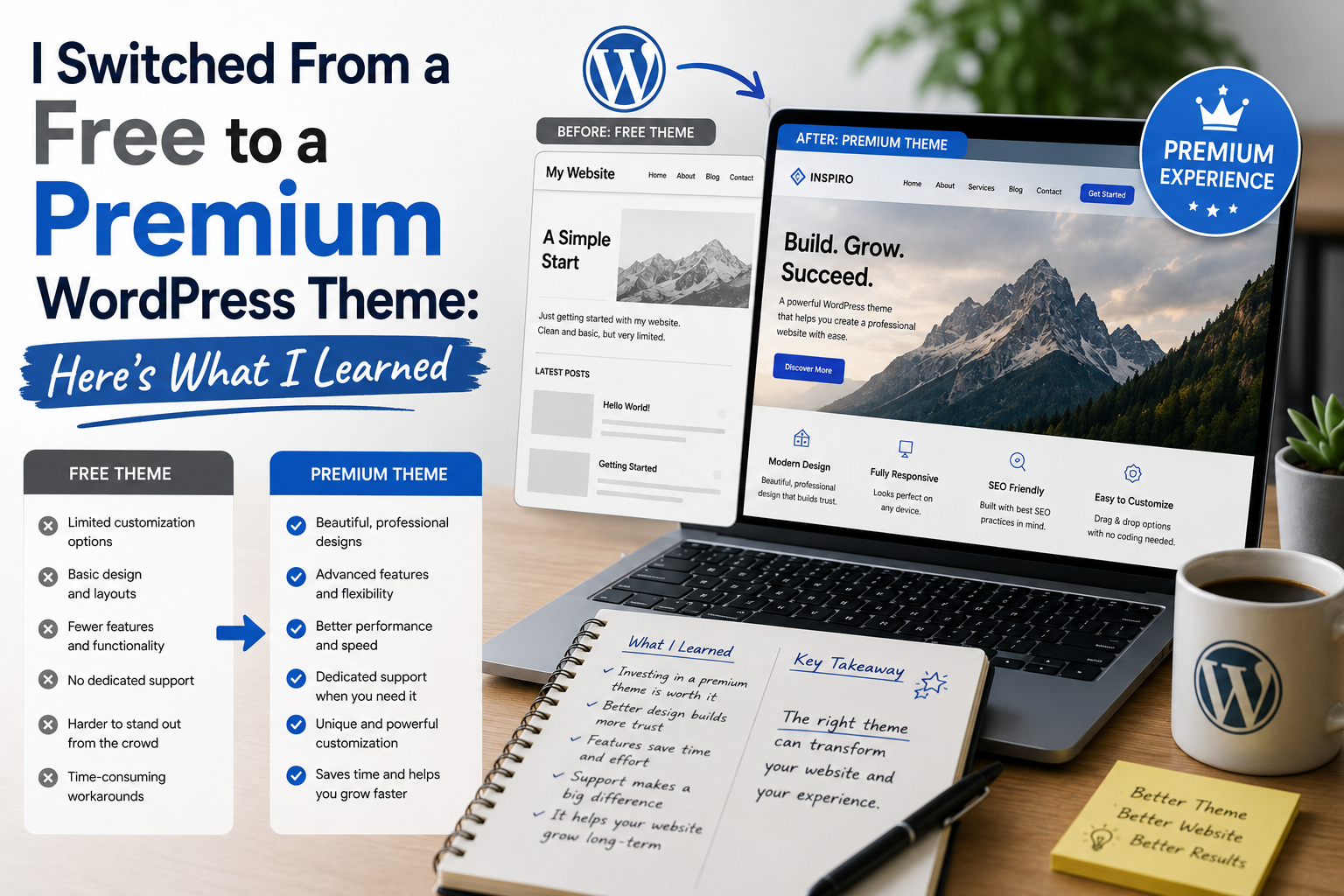
For a long time, I was perfectly comfortable using free WordPress themes. They were easy to install, inexpensive, and often provided everything I needed to get a website online.
But eventually, I started wanting more.
I wanted greater control over the layout, more customization options, better design flexibility, and a workflow that would require less manual tweaking. That was when I decided to switch from a free WordPress theme to a premium one.
The experience was more educational than I expected. Some improvements were immediately noticeable, while others were less important than I had imagined.
Why I Decided to Switch
My decision did not come from suddenly disliking free themes.
In fact, free themes can be excellent choices for many websites.
My problem was that I had started spending too much time trying to make my existing theme behave the way I wanted.
I wanted more control over headers, typography, layouts, navigation, and other visual elements.
After comparing several options, I decided that paying for a premium theme could potentially save me time in the long run.
That was my main goal—not simply having a more expensive design.
My First Impression
The installation process was relatively straightforward.
After downloading the theme from its legitimate source, I uploaded the ZIP file through the WordPress dashboard and activated it.
WordPress officially supports installing themes by uploading a ZIP file through the administration interface.
The first thing I noticed was the number of customization options.
Compared with my previous theme, there were significantly more controls for layouts, fonts, menus, headers, footers, and other design elements.
At first, I was impressed.
Then I realized I had a lot to learn.
More Options Were Both Good and Bad
One of the biggest differences was the amount of control.
With the free theme, I sometimes had to accept certain design decisions or find workarounds.
The premium theme gave me more freedom.
I could make changes without touching as much code.
However, more options also meant more decisions.
I spent quite a bit of time experimenting with settings that I ultimately did not use.
That taught me an important lesson: features only have value when they solve an actual problem.
A theme with hundreds of options is not necessarily better than a simpler theme.
The Demo Looked Better Than My Website
This was probably the biggest surprise.
The premium theme’s demonstration website looked fantastic.
My website did not immediately look the same after installation.
I eventually understood why.
Theme demos are usually carefully designed with specific images, menus, content, layouts, and configurations.
My website had completely different content and settings.
The theme provided the framework, but I still had to configure it.
This changed how I evaluate theme demonstrations.
I now see them as examples of what is possible rather than guaranteed results.
Customization Became Much Easier
Once I understood the theme, customization became one of my favorite parts.
I could adjust typography, spacing, colors, navigation, and layouts more easily.
For someone who regularly manages website content, this can save considerable time.
WordPress also continues to expand block-based customization, with block themes supporting tools such as the Site Editor and global style controls.
The key benefit for me was not having more buttons.
It was being able to make useful changes without constantly searching for custom code.
I Started Paying More Attention to Compatibility
Before switching themes, I did not think much about compatibility.
After switching, I became more cautious.
My website already contained plugins, menus, widgets, pages, and custom settings.
Changing the theme could affect how some of those elements appeared.
Everything did not necessarily break, but some things required adjustment.
That taught me to test a major theme change before applying it to an important production website.
Having a recent backup also became part of my preparation.
Performance Still Mattered
I initially expected the premium theme to automatically make the website better.
That was not necessarily true.
A theme can provide beautiful designs while still requiring careful configuration.
Website performance can depend on many factors, including hosting, plugins, images, scripts, and theme implementation.
I therefore stopped judging themes purely by appearance.
A good-looking website that feels slow is not a great experience.
Updates and Support Were Valuable
One area where I appreciated the premium approach was access to ongoing updates and documentation.
A theme is not something I want to install and forget.
WordPress themes can receive updates from their authors, including improvements and compatibility changes.
Clear documentation also helped me understand features without spending hours experimenting.
This became one of the factors I considered when deciding whether a premium theme was worth its price.
Was the Premium Theme Worth It?
For my situation, yes.
But I would not say that everyone needs a premium theme.
If a free theme provides the design and functionality a website needs, there may be no reason to spend extra money.
For me, the value came from convenience.
I saved time when customizing the website and had more control over its appearance.
The premium price was justified because it solved specific problems I was already experiencing.
What I Would Do Differently
If I could repeat the process, I would spend more time evaluating the theme before purchasing it.
I would check:
- Update history
- Documentation
- Support options
- Plugin compatibility
- Customization features
- Performance
- Licensing terms
- WordPress compatibility
I would also avoid choosing a theme simply because its demo looks impressive.
Where I Download Themes Today
For free themes, I prefer the official WordPress Theme Directory.
Download WordPress Themes from WordPress.org
It provides a large collection of themes and is a much safer starting point than downloading unknown files from random websites.
For premium themes, I recommend downloading directly from the developer or authorized marketplace where the theme was purchased.
I avoid unofficial, cracked, or “nulled” themes because modified theme files can create security and maintenance risks.